This space displays different documents available in the Media Library of the Ministry of Agriculture, Fisheries and Food.
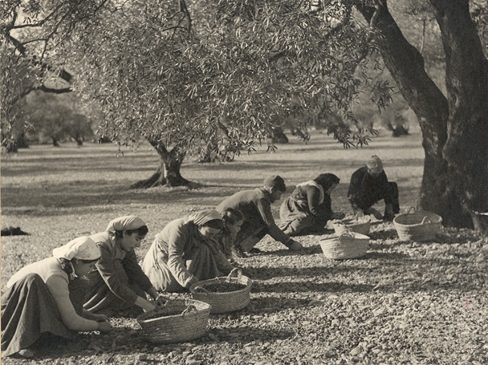
The Media Library integrates historical and current photographic and film archives produced by the Ministry of Agriculture, Fisheries and Food, as well as donated private collections, and seeks to facilitate their reuse. These archives constitute a valuable documentary heritage of particular interest in our current image-driven society for understanding the evolution of agriculture, the environment, and rural society.
The origin of agriculture with the Neolithic period, around ten thousand years before Christ, allowed, at the same time and place, a surplus of food and human settlements, thus being the origin of the development of permanent civilizations as we know them.
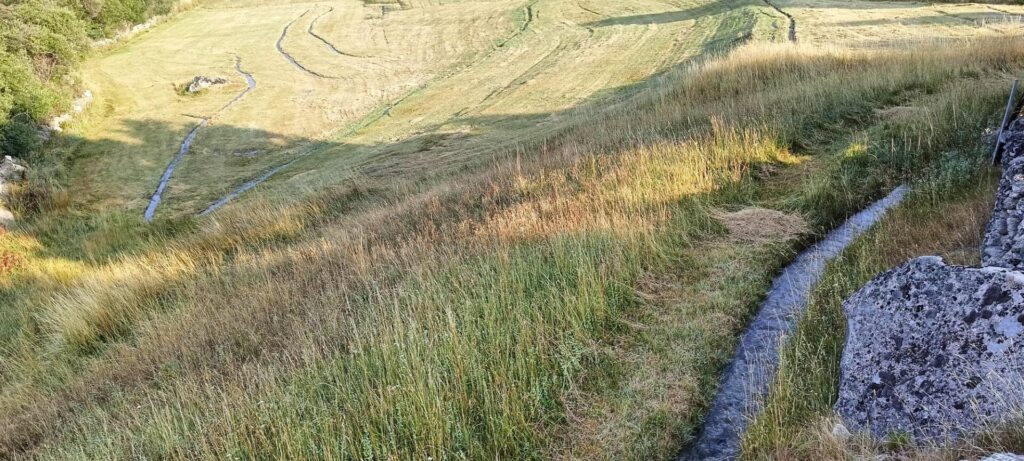
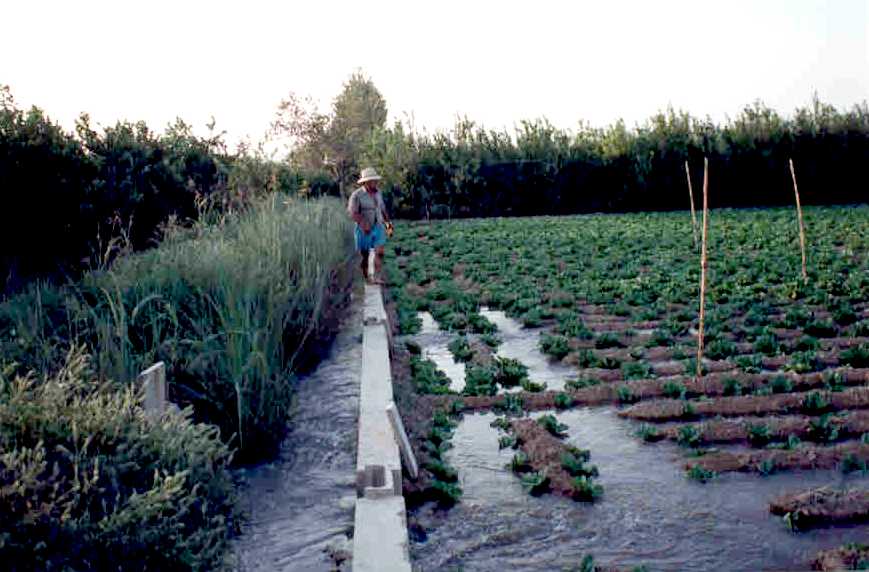
The word agriculture comes from Latin, composed of "campo" (field) and "cultura" (culture), a culture in which irrigation has developed to the present day. Currently, the Spanish State, through its Ministry of Agriculture, Fisheries and Food, along with the relevant national and regional authorities, provides institutional support for agriculture.
This humanistic and technical dimension allows us to connect with those initial risks, in order to understand the reality in which we find ourselves and project ourselves.
The OSR has developed a calculator for traditional local units of measurement used in agriculture.
For the documentation of this work, the publication “Unit Conversion Factors” by Alberto Benítez, 1975 (Bellisco Technical Bookstore) was used, which compiles these measures, using as a basic source of information the publication “Weights, Measures and Coins” of the Ministry of Agriculture.
“These ancient measurements have the most varied and picturesque origins: many refer to body measurements (span, pace, foot, fathom), many others to agricultural tasks (the area a team of oxen can plow in a day, or the area sown with a certain weight of seed, etc.). Frequently, the unit changes depending on the product being measured. It also often varies dramatically with geography; towns separated by only a few kilometers sometimes have completely different units.” (Benítez, A. 1975)
This calculator allows you to select, for each province and area, its traditional local unit of measurement, and calculate its equivalent in other traditional units, as well as in the decimal metric or international system of units.
The OSR has developed a calculator for traditional local units of measurement used in agriculture.
For the documentation of this work, the publication “Unit Conversion Factors” by Alberto Benítez, 1975 (Bellisco Technical Bookstore) was used, which compiles these measures, using as a basic source of information the publication “Weights, Measures and Coins” of the Ministry of Agriculture.
“These ancient measurements have the most varied and picturesque origins: many refer to body measurements (span, pace, foot, fathom), many others to agricultural tasks (the area a team of oxen can plow in a day, or the area sown with a certain weight of seed, etc.). Frequently, the unit changes depending on the product being measured. It also often varies dramatically with geography; towns separated by only a few kilometers sometimes have completely different units.” (Benítez, A. 1975)
This calculator allows you to select, for each province and area, its traditional local unit of measurement, and calculate its equivalent in other traditional units, as well as in the decimal metric or international system of units.



 English (UK)
  Español
  Français
  Català
  Galego
  Euskara